
|
|

|
|
Course Information Home • Syllabus Assignments Reading Style Guide Copying / Plagiarism Copyright Lectures 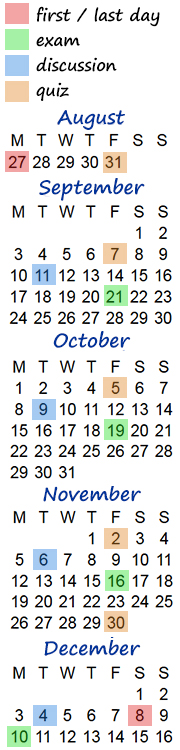
|
Biology 120 Natural History Syllabus Instructor: Larry Jon Friesen, PhD Course Email Address: 120bio.fall@naturenotes.net Required Textbook Friesen, Larry Jon. 2019. Natural History. Kailua Kona, Hawaii: NatureJournal. ISBN: 978-0-9800267-4-0. Nature of the Course Natural History is a general biology course emphasizing the integration of the natural sciences necessary for an understanding of the distribution and diversity of life on Earth. Natural History (Biology 120) satisfies the SBCC General Education Requirement in Natural Sciences and transfers to all UC and California State University campuses where it also satisfies a general education requirement for a life science laboratory course. General Topic Sequence Earth: Land, Sea and Sky Biodiversity: Evolution and Diversity Biochemistry: Cell Structure and Function Physiology: How Life Works Behavior: Perception, Integration, Response Ecology and Biogeography: Population, Community, Ecosystem; Distribution of Life on Earth Natural History Student Learning Outcomes 1. Identify and/or describe major geological, meteorological, and historical forces that shape global and local landscapes. 2. Describe ecological relationships between organisms and their environment. 3. Use modern classification to distinguish major groups of organisms based on their structure, behavior, physiology, and life history. 4. Recognize common organisms of local habitats and the environmental factors, both physical and biological, that affect community structure and describe the adaptations that make each species successful in its habitat. Required Assignment Due Dates See course calendar in column at left.
Establishing a Turnitin Account Submit your lab reports, exams and essays through Turnitin: http://www.turnitin.com Turnitin is a website subscribed to by all California Community Colleges that allows students to submit papers using a wide variety of word-processing programs and that will preserve your formatting. Instead of emailing your exams to me, you will submit them through Turnitin following the directions below. You will need the following information: Turnitin Class ID: 18539537 (write this down) Turnitin Class Enrollment Password: fall2018 (write this down) 1. Open the Turnitin web site at http://www.turnitin.com 2. Select "Create Account" in the upper right-hand corner. If you already have an account, simply login. Your login is the email address you used to create an account and the password you created at that time. If you cannot remember your Turnitin login, simply create a new account. 3. Select "Student" on the next page. 4. Enter the Turnitin Class ID 18539537 and the Turnitin Class Enrollment Password fall2018 on the next page. 5. Then, follow instructions for creating your personal profile. How to Purchase the Textbook Subscription You must purchase the textbook subscription on or before the end of the first week of class in order to complete assignments and to remain in class. Required course assignments are linked from the textbook. Friesen, Larry Jon. 2019. Natural History. Kailua Kona, Hawaii: NatureJournal. ISBN: 978-0-9800267-4-0. The text is incorporated into the course website and will appear as a seamless component of the course. There is no printed version of the textbook (we are biologists, save a tree), nothing will be sent to you, and, your first access to the course and the textbook will be the weekend before the first day of class. The Natural History textbook is sold through NatureJournal who sells directly to students in order to reduce costs. In order to purchase the digital textbook subscription, go to the following URL and enter the NatureJournal username and password: http://www.naturejournal.net/sbcc/index.htm username: nature password: symbiosis Note: this username and password is NOT your course login; it is supplied by NatureJournal and used ONLY for the purchase of the text subscription from NatureJournal. The cover image of Natural History is a sea turtle being cleaned by brown surgeonfish. 1. Click on the "purchase subscription" to the right of the cover. 2. If requested, enter the username and password above and click "OK". 3. Accept the terms of the license agreement on the following page by clicking "I Accept". 4. On the "Natural History" page, enter your name. (If someone else is purchasing the textbook for you, have them enter YOUR name in the box, not theirs.) 5. Complete the sale with a credit or debit card. NatureJournal uses PayPal as a secure sales channel. Nature of the Graded Assignments Lecture Examinations There are four lecture examinations required in order to be eligible for a passing grade in the course, regardless of points earned. The questions for each lecture exam are presented at least two weeks before their due dates. In a sense, these assignments are similar to take-home exams in a traditional class and you may use any resources available to research your answers. The course lectures and the online textbook will support your answers, but it is likely that you will expand your search for information to other sources. You must use at least five sources in writing each examination and list these in a References section at the end of the assignment. The course lectures and textbook must be used and listed as two of your sources. Each of the examinations causes you to write short essays that address several topics that are posed as separate questions each of which must be answered for full credit. Typically, there are four questions on each exam and the combined length of all answers (the total for the complete exam, excluding References) has a minimum word count of 2,000 words. The best exams often are much longer than the minimum. Each examination will earn up to 100 points. Lecture exams are submitted to Turnitin. Late Exam Policy The long lead time prior to deadlines should allow researching, writing and submitting exams early. Generally, late submission of an exam is not allowed except for emergencies and an extension must be requested prior to the due date. Depending on the emergency, late point deductions of up to five points per day may be applied. Medical emergencies are approved without deductions, but official verification must be submitted. Submitting Lecture Examinations is Required Submitted assignments are the means by which participation ("attendance") is evaluated. Submission of four original exams is required in order to be eligible for a passing grade and to remain in the course. Missing assignments is equivalent to missing class meetings in a traditional course. Examinations due before the last date to drop with a "W" must be submitted as evidence of participation in the class and, if not submitted, the student will be dropped for non-participation. Failure to submit exams with due dates after the last date to drop with a "W" will result in a failing grade. Expository Writing All essays for exams must be original with no copied material from your sources. These assignments are designed to give you practice in re-writing, in your own words, the ideas of others. It is assumed that your essays will be written at the college level using the proper structure of expository writing. Expository writing informs, explains, clarifies, or defines. The writing informs through a carefully crafted presentation of key points, explanations, and supportive details. The writing contains clear ideas that are focused and fully explained. The writer uses a variety of credible resources to gather accurate, relevant information that provides a strong base of support in the form of facts, examples, and explanations. Strong writers recognize that greater stylistic distance is required in a formal, academic paper than in an informal, personal paper, but that expository writing can be lively, engaging, and indicative of the writer's commitment to the topic. Essays demonstrate strong control of a wide range of standard writing conventions . . . punctuation, spelling, capitalization, and grammar are correct and enhance communication. Points will be deducted for excessive misuse of the English language. Discussion Questions and Quizzes Opportunities for comparing ideas with fellow students and testing your comprehension of textbook chapters are provided by discussion questions and quizzes. Consider these to be similar to review questions that often are distributed before exams. A discussion topic is posted before each exam and your responses are available to all students. Compare and comment on discussion answers in an effort to increase understanding and to evaluate different methods and styles for responding to exam questions. In addition, a quiz is posted before each exam allowing you to evaluate your understanding of textbook chapters. Answers to quiz questions are posted after the due date. Participtaing in discussions and submitting quizzes is one measure of your participation in the course. Laboratory Reports There are ten Laboratory Reports required, and are worth 10 points each. The format of the Lab Reports varies from lab to lab, and may take the form of short written descriptions, diagrams, photographs, answers to questions, etc. Specific directions are given for each lab report on the corresponding page of the lab manual. Lab reports are submitted to Turnitin. Late lab reports are accepted with minimal point deductions; however, at least five lab reports must be submitted before the last date to withdraw from the course with a "W". The last day to submit any lab is the last day of instruction. Submitting Laboratory Reports is Required Natural History is a laboratory course and you receive one grade for the lecture and laboratory together. There are ten required laboratory reports. Each laboratory exercise involves completion of an exercise and the submission of a laboratory report based on the results. The format of the laboratory reports varies from lab to lab, and may take the form of short written descriptions, diagrams, photographs, answers to questions, etc. Specific directions are given for each lab report on the corresponding page of the lab manual. Lab reports are submitted to Turnitin. Late lab reports are accepted with minimal point deductions; however, at least five lab reports must be submitted before the last date to withdraw from the course with a "W". At least eight lab reports must be submitted by the end of the week prior to the last week of instruction (see Calendar) to avoid point deductions. The last day to submit any lab report is the last day of instruction. Student Evaluation Course grades are determined by your total point score according to the following scale:* Four Lecture Exams: 400 points, 100 points each Ten Laboratory Reports: 100 points, 10 points each Assignment Grade Scale (percent): A 100 - 85; B 84 - 75; C 74 - 65; D 64 - 55; F 54 - 00 Course Grade Scale (points): A 500 - 425; B 424 - 375; C 374 - 325; D 324 - 275; F 274 - 000 * Pass / NoPass Option: P low middle C (340) or above; NP 339 and below. * Important Notes about Grades and Participation 1. Submission of assignments is a measure of course participation/attendance. Failing to submit assignments, particularly early in the course, will result in dismissal similar to a traditional, onsite class requiring attendance. 2. Regardless of points earned, original answers for examinations must be submitted in order to be eligible for a passing grade in the course. An exam far short of the minimum word count may not be accepted. 3. The minimum number of eight labs must be submitted by the end of the course for a maximum point count of 80. It is better to submit all ten labs for a maximum of 100 points. If fewer than eight labs are submitted, a penalty of 10 points will apply to each missing lab below eight at the end of the course. 4. Do not plagiarize, copy or quote any material on exams. If plagiarism, quotations or copying is detected in your answers, your score will be reduced significantly; you may receive a zero and in severe cases, your assignment will not be accepted as having been submitted. Copying and plagiarism are treated equally. Copying is using passages with little or no change, but referencing the source; plagiarism is using passages with little or no change, and not referencing the source. Quoting passages also is prohibited. All of your answers must be written in your own words. If there is extreme copying or plagiarism, your submission will not be considered as having met the guidelines for a successfully submitted original assignment and you may be dropped prior to the final drop date, or you may receive a course grade of F if your assignment is submitted after the final drop date and is not accepted as having met the conditions of submission. Recommendations 1. You are a science reporter. You are not creating information; you are reporting information from your reading. And, just as many reporters can write different original articles or reviews for newspapers, you can write a different original answer to exam questions. The exams give you practice in re-writing the works of others while avoiding copying. I frequently hear that "it just can't be written any other way." However, by combining ideas, reformulating concepts, changing sequence, and providing your own writing style, it is easy to rewrite an essay in innumerable ways. 2. Begin writing your exams early and meet the word count minimum of 2,000 words for each exam. Exams shorter than the minimum word count will receive point deductions: one point for every 20 words, or portion thereof, you are short the 2,000 word minimum for exams. Exams that are far short of the minimum may not be accepted. Do not submit short exams. Submitting a short exam generally means that you have not provided a sufficient response to the question(s) and have lost points on content; then, in addition, you lose more points due to low word count --double jeopardy. 3. Complete each question and all subparts of each question on exams. Each question may contain a general question and several subparts that you are to include within your answer. Sometimes, students fail to answer each subpart and lose points. Points are assigned to every part of each question. Print out the exam prompts and cross out each aspect of the question as you proofread your final draft to assure that all aspects have been covered. 4. Read and follow the Style Guide for exams. You must supply a header with your name, your password code, your email address and the exam number as shown in the Style Guide. Each answer must be numbered and sequenced in the same order as the exam questions; however, do not include the exam questions on your exams. Do not include "in text citations" in your answers; however, you must list all sources used in a properly formatted References section at the end of the each exam. Failing to follow the guidelines as explained in the Style Guide will result in point deductions. 5. Complete all required assignments. Each exam must be original and must be submitted for you to be eligible for a passing grade in the course. Failure to submit an exam will result in a failing grade or dismissal from the course. 6. Meet assignment deadlines. No extensions are given except for a serious emergency or verified medical excuses. Otherwise, late exams may not accepted or may be accepted with late penalties. Failing to submit required exams after the last day to withdraw will result in a failing course grade. 8. Contact me early if you need help. I can be a tremendous help when you have questions about course content and strategies for successful course completion. I can create new art and new sections authored to meet your needs. Researching the Exam Questions Google Scholar Of course, Google will take you to many popular articles, many of which will be appropriate for the course. Google has a special section for "scholarly" articles. You can reach this section at: http://scholar.google.com/ Many of these articles require that you pay a fee; however, some do not. Also, you can use Google Scholar to search for articles and then see if they are available for free through EBSCOhost, a database of scholarly articles provided to you as an SBCC student. EBSCOhost databases SBCC's Luria Library has access to the EBSCOhost databases of journal articles that would otherwise require a subscription. You can access these online with your Pipeline login. You can reach the login page for the online databases here: http://library.sbcc.edu/onlinedatabases.html Enter your SBCC Pipeline login (not your course login). Once logged in, you will have full access to a vast collection of journals including Science and Nature (although the current year is not available for Nature and the last two years for Science . . . but earlier articles are available as full-text). There are many other journals available. A wealth of information is available and you can do an advanced search that can allow you to focus on specific areas of the exam questions. Wikipedia I am always asked about Wikipedia as a resource . . . there is no good answer. The articles are written by a wide variety of people and receive little review. Some articles are quite scholarly and some are completely trash. Check your facts. Remember, you are responsible for inaccurate statements on assignments, not the author of a Wikipedia article. However, ANY resource can be used as long as you list it in your References section at the end of the assignment. Wikipedia is one website and counts as one source. |
 |  |